
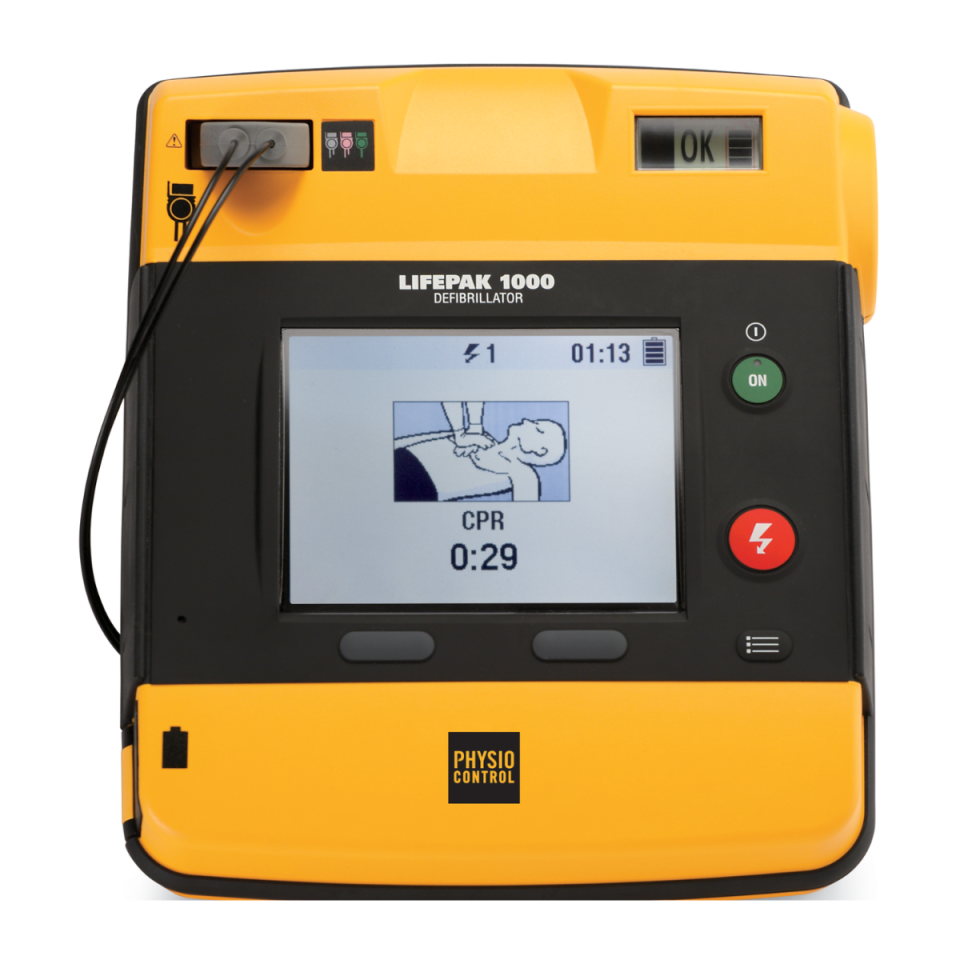
LIFEPAK 1000 AED with Graphical Display
The LIFEPAK 1000 AED with Graphical Display is a semi-automatic defibrillator from Stryker for trained first responders. Voice prompts and on-screen text and pictures guide the rescuer through each step, shock energy increases up to 360 joules if further shocks are needed, and the IP55-rated case resists dust and water. For teams that include clinicians trained to read heart rhythms, Stryker also makes the LIFEPAK 1000 AED with ECG Display and Manual Override.
Key features
- Semi-automatic: the AED analyses the heart rhythm, and you press the shock button only when a shock is advised
- Voice prompts plus text and graphics on a 120 x 89 mm backlit screen
- Escalating biphasic energy, configurable from 150 to 360 joules (default 200, 300, 360 J)
- cprMAX technology, with an option for CPR to continue while the AED charges
- IP55 rated and drop-tested from 1 metre onto every corner, edge and surface
- Battery provides up to 440 shocks at 200 J or about 17 hours of on time, with a 5-year standby life
- Daily and monthly automatic self-tests, with an OK symbol on the readiness display
- Suitable for children under 8 years or under 25 kg with Infant/Child electrodes (sold separately)
- Supplied with 1 set of adult electrodes, a battery and a carry case
- 5 year manufacturer's warranty
What's included
- 1 x LIFEPAK 1000 AED with Graphical Display
- 1 x set of adult QUIK-COMBO electrodes with REDI-PAK preconnect, up to 2-year shelf life
- 1 x LIFEPAK 1000 non-rechargeable battery, up to 5-year shelf life
- 1 x carry case
- 5 year manufacturer's warranty
Need more information ? Call 01298 872186 or use our live web chat function. If your organisation needs a formal quote, our team will be happy to put together a quote for you.
Specifications
|
Specification |
LIFEPAK 1000 AED with Graphical Display |
|---|---|
|
Manufacturer part number |
99425-000094 |
|
Type |
Semi-automatic AED |
|
Operating mode |
AED mode |
|
Waveform |
ADAPTIV biphasic truncated exponential, impedance compensated |
|
Patient impedance range |
10 to 300 ohms |
|
Energy |
150 to 360 J, configurable. Default 200, 300, 360 J |
|
Energy with Infant/Child electrodes |
Selected energy divided by 4, maximum 86 J |
|
Analysis time |
Under 10 seconds (motion may add up to 10 seconds) |
|
Charge time (new battery) |
Under 9 s to 200 J. Under 15 s to 360 J |
|
Power on to shock ready |
Under 25 s at 200 J. Under 30 s at 360 J |
|
3-shock sequence (200, 300, 360 J) |
Under 70 seconds |
|
Display |
320 x 240 dot backlit LCD, 120 x 89 mm active area |
|
Prompts |
Voice prompts, on-screen text and graphics |
|
Battery |
Non-rechargeable Li/MnO2, 12 V, 4.5 Ah |
|
Battery capacity (new) |
Up to 440 shocks at 200 J or 1,030 minutes on time [VERIFY] |
|
Battery standby life |
5 years installed |
|
Self-tests |
At power on, plus automatic daily and monthly tests |
|
Data storage |
2 patient records. At least 40 minutes of ECG for the current patient |
|
Data transfer |
Infrared (IrDA) to PC |
|
Ingress protection |
IP55 (IEC 60529), with battery and REDI-PAK electrodes installed |
|
Drop |
MIL-STD-810F, 1 m onto each corner, edge and surface. EN 1789 |
|
Vibration |
MIL-STD-810F, Method 514.5, ground vehicle |
|
Operating temperature |
0 to 50°C |
|
Storage temperature |
-30 to 60°C for up to 7 days. Electrodes are best stored at 15 to 35°C |
|
Relative humidity |
5 to 95%, non-condensing |
|
Dimensions |
H 8.7 cm x W 23.4 cm x D 27.7 cm |
|
Weight |
3.2 kg with battery and REDI-PAK electrodes |
Key features explained
How does semi-automatic operation work?
The LIFEPAK 1000 checks the patient's heart rhythm through the defib pads and decides whether a shock is needed. The rescuer then delivers it by pressing the shock button. The check takes 6 to 9 seconds. If a shock is advised, the AED charges, tells everyone to stand clear, and the shock button flashes. If the button is not pressed within 15 seconds, the AED cancels the charge. It will not allow a shock unless it has advised one.
What does the graphical display show?
The screen shows each step as text and simple pictures, such as where to place the pads, matching the voice instructions. It also shows a CPR countdown timer, the number of shocks given, the time elapsed and the battery level.
Who is the Graphical Display model for?
It suits trained responders who follow AED prompts rather than read heart rhythms. Examples include community first responders, trained workplace first-aiders, security teams, police, fire and event first aid. Stryker intends the LIFEPAK 1000 for operators with CPR training, defibrillator training and training on this device. If you are equipping a public space for untrained bystanders, call us to talk through whether a fully automatic AED would suit you better.
How does shock energy change during a rescue?
The first shock is delivered at 200 joules by default. If the AED advises more shocks, it moves to 300 J and then 360 J, and stays at 360 J for any shocks after that. The rescuer does not choose the level. The AED follows a sequence set up in advance, which can range from 150 to 360 J, and adjusts each shock to the patient's body resistance. Stryker cites the BIPHASIC Trial (Stiell et al., Circulation, 2007) in support of escalating energy.
How does it guide CPR?
The AED tells the rescuer when to start and stop CPR, and shows a countdown timer on screen during each CPR period. These prompts are part of Stryker's cprMAX technology, which can be set up to match your organisation's resuscitation protocol. For example, you can set how long each CPR period lasts (15 to 180 seconds, 2 minutes by default) and whether compressions continue while the AED charges. Stryker advises that changes are made only under the direction of a doctor familiar with resuscitation.
Where can it be kept and carried?
The LIFEPAK 1000 suits workplaces, events and response vehicles. It weighs 3.2 kg and comes with a carry case, so one person can take it to the patient. The case is rated IP55 against dust and water, and the AED operates from 0 to 50°C. It passes drop tests from 1 metre and vibration tests for vehicles. If you use it in a moving vehicle, stop before the AED analyses, as movement can affect the reading.
How do you know it is ready to use?
The readiness display on the top of the AED shows an OK symbol when the last self-test passed, plus the battery level. A wrench symbol appears if there is a problem that prevents, or could prevent, normal operation. In an emergency, Stryker advises using the AED even if the wrench is showing, then contacting service. The AED tests itself each time it is switched on, and runs an automatic self-test daily and monthly at 03:00 when not in use.
What can the battery deliver?
Fitted in an AED that is not used, a new battery provides 5 years of standby power, including the automatic self-tests. In a rescue, a new battery supports up to 440 shocks at 200 J or about 17 hours of use. The AED warns you when the battery is running low, with at least 30 shocks or 75 minutes still left. A gauge on the battery shows its charge before you fit it.
Can we review a rescue afterwards?
Yes. The AED keeps a record of each rescue, including the heart rhythm and a time-stamped log of shocks and events. It holds this for the current and previous patient. You can transfer the record to a PC and review it with Stryker's CODE-STAT software, which can support debriefs and refresher training.
What happens when the ambulance arrives?
The pads can usually stay on the patient. The adult electrodes use Stryker's QUIK-COMBO connector, so if the ambulance crew carries a LIFEPAK monitor, they can connect it to the same pads. The screen shows how many shocks have been given, which helps with the handover.
Frequently asked questions
Is the LIFEPAK 1000 semi-automatic or fully automatic?
The LIFEPAK 1000 is semi-automatic. It analyses the heart rhythm and advises whether a shock is needed, but the rescuer must press the shock button to deliver it. In AED mode, it will only allow a shock that it has advised.
Who can use the LIFEPAK 1000?
Stryker intends the LIFEPAK 1000 for trained responders. Its operating instructions specify CPR training, defibrillator training and training on the LIFEPAK 1000, with authorisation from a physician or medical director. Our onsite AED training can help your team meet this.
Can the LIFEPAK 1000 be used on children?
Yes. For a child under 8 years old or under 25 kg, fit Infant/Child electrodes (sold separately) instead of the adult pads. They connect directly to the AED and reduce the shock energy to a quarter of the adult setting, up to 86 J. Paediatric QUIK-COMBO electrodes are not suitable, as they do not reduce the energy from this AED. For anyone aged 8 or over, or over 25 kg, use the adult pads.
How often does the LIFEPAK 1000 battery need replacing?
Replace it every 5 years if the AED is not used, or sooner if the AED gives a low battery warning or the readiness display shows one bar or fewer. Every rescue and every automatic self-test uses some charge. Stryker recommends keeping a spare battery, which has a 5-year shelf life.
How long do LIFEPAK 1000 pads last?
The adult electrodes have a shelf life of up to 2 years. Check the Use By date printed on the packet. Once removed from the foil packet, do not use them, and replace them.
Is the LIFEPAK 1000 waterproof?
The LIFEPAK 1000 is water-resistant, not waterproof. Its IP55 rating means protection against dust ingress and low-pressure water jets from any direction, with the battery and electrodes fitted. It must not be immersed in water.
How often should we check the LIFEPAK 1000?
Stryker recommends a weekly check if the AED is rarely used. Confirm the readiness display shows the OK symbol, check the battery level, and check the Use By date on the electrode packet. If the wrench symbol appears, contact service, but in an emergency use the AED anyway.
Is this the same LIFEPAK 1000 sold under the Physio-Control and Medtronic names?
Yes, it is the same product line. Earlier units carry the Medtronic or Physio-Control name, and the LIFEPAK range is now made by Stryker. Current units may still show the Physio-Control logo on the front.
| Brand | Physio Control |
|---|