
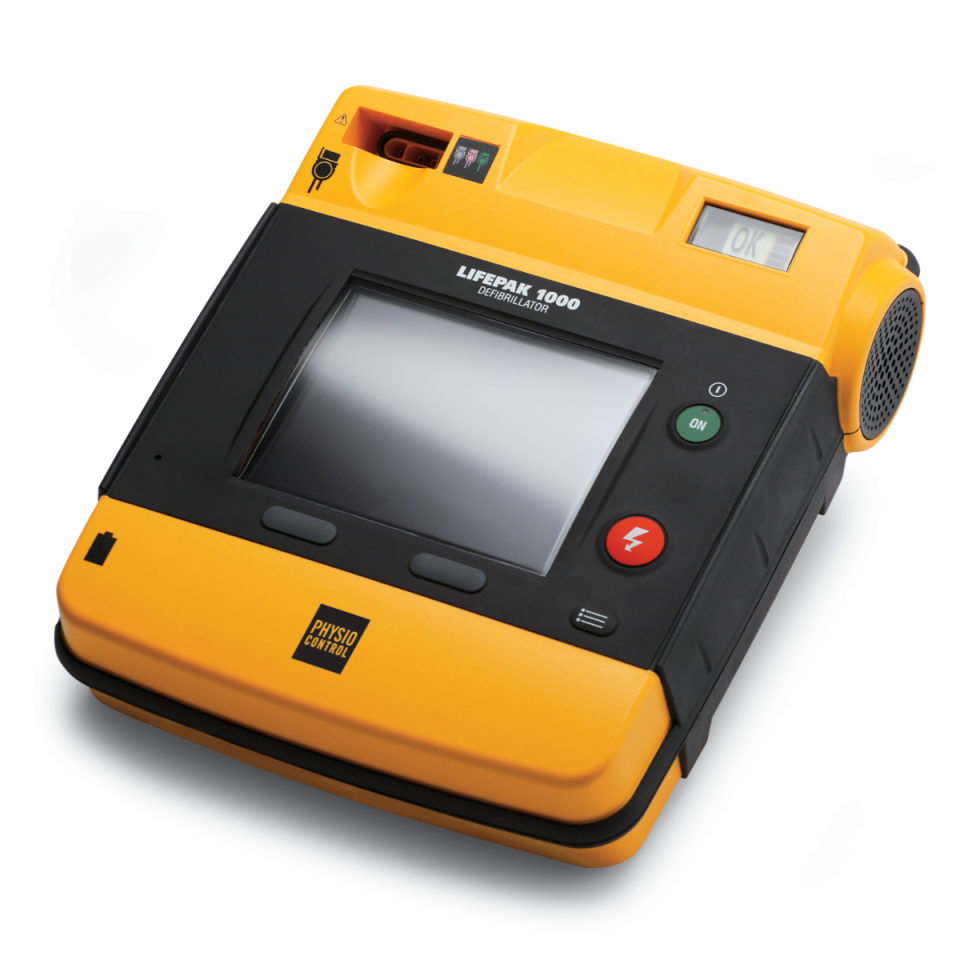
LIFEPAK 1000 AED with ECG Display and Manual Override
The LIFEPAK 1000 AED with ECG Display and Manual Override is a semi-automatic defibrillator from Stryker for clinicians and teams trained in ECG recognition. It adds an on-screen ECG trace and heart rate, a Manual mode in which the operator controls charging and shocks, and 3-lead ECG monitoring. Everything else matches the LIFEPAK 1000 AED with Graphical Display, including escalating energy to 360 joules and an IP55 rating.
Key features
- Shows the patient's heart rhythm (ECG trace) and heart rate on screen
- Manual mode lets a trained clinician decide when to give a shock, instead of the AED deciding
- Monitors the heart rhythm through a 3-lead cable (sold separately), including in conscious patients. It cannot shock in this mode, and prompts you to attach the pads if a shock may be needed
- Standard AED mode talks first responders through each step with voice and on-screen instructions
- Settings let you hide the heart trace and lock Manual mode, so first responders see only the step-by-step instructions
- Shock energy level increases if needed, up to 360 joules, and can be adjusted in settings
- cprMAX technology keeps pauses in chest compressions short, including while the AED charges
- Dust and water resistant (IP55) and drop-tested from 1 metre
- Supplied with 2 sets of adult electrodes, a battery and a carry case
- 5 year manufacturer's warranty
What's included
- 1 x sets of adult QUIK-COMBO electrodes with REDI-PAK preconnect, up to 2-year shelf life [VERIFY SKU]
- 1 x LIFEPAK 1000 non-rechargeable battery, up to 5-year shelf life
- 1 x ECG cable
- 1 x carry case
- 1 x operational manual
Need more information? Call us on 01298 872186. If your organisation needs a formal quote, pro-forma invoice or purchase order, we will be happy to prepare one for you.
Specifications
|
Specification |
LIFEPAK 1000 AED with ECG Display and Manual Override |
|---|---|
|
Manufacturer part number |
99425-000096 |
|
Type |
Semi-automatic AED with manual override |
|
Operating modes |
AED mode, Manual mode, ECG mode |
|
ECG display |
Non-diagnostic. 0.55 to 21 Hz, 25 mm/s, 1 cm/mV |
|
ECG sources |
Therapy electrodes, or 3-wire cable in Lead II |
|
Heart rate display |
20 to 300 bpm |
|
Waveform |
ADAPTIV biphasic truncated exponential, impedance compensated |
|
Patient impedance range |
10 to 300 ohms |
|
Energy |
150 to 360 J, configurable. Default 200, 300, 360 J |
|
Energy with Infant/Child electrodes |
Selected energy divided by 4, maximum 86 J |
|
Analysis time |
Under 10 seconds (motion may add up to 10 seconds) |
|
Charge time (new battery) |
Under 9 s to 200 J. Under 15 s to 360 J |
|
Power on to shock ready, Manual mode |
Under 20 s at 200 J. Under 25 s at 360 J |
|
Power on to shock ready, AED mode |
Under 25 s at 200 J. Under 30 s at 360 J |
|
Display |
320 x 240 dot backlit LCD, 120 x 89 mm active area |
|
Battery |
Non-rechargeable Li/MnO2, 12 V, 4.5 Ah |
|
Battery capacity (new) |
Up to 440 shocks at 200 J or 1,030 minutes on time [VERIFY] |
|
Battery standby life |
5 years installed |
|
Self-tests |
At power on, plus automatic daily and monthly tests |
|
Data storage |
2 patient records. At least 40 minutes of ECG for the current patient |
|
Data transfer |
Infrared (IrDA) to PC |
|
Ingress protection |
IP55 (IEC 60529), with battery and REDI-PAK electrodes installed |
|
Drop |
MIL-STD-810F, 1 m onto each corner, edge and surface. EN 1789 |
|
Operating temperature |
0 to 50°C |
|
Relative humidity |
5 to 95%, non-condensing |
|
Dimensions |
H 8.7 cm x W 23.4 cm x D 27.7 cm |
|
Weight |
3.2 kg with battery and REDI-PAK electrodes |
Key features explained
What does manual override do?
Manual override lets a trained clinician decide when to give a shock, instead of the AED deciding. To switch to Manual mode, press the MENU button and select YES. The clinician reads the heart rhythm on screen, presses CHARGE if a shock is needed, makes sure nobody is touching the patient, then presses the flashing shock button. DISARM cancels a charge at any time. To return to AED mode, press MENU again and select YES.
Manual mode can also be set up to show an ANALYZE button, which asks the AED for its own assessment. If the AED advises a shock, it starts charging, and the clinician can still cancel with DISARM.
Who is the ECG model for?
It suits personnel trained in ECG recognition, such as paramedics, doctors, nurses and event medics. It also suits organisations with mixed skills. Stryker describes a tiered response: a first responder starts in AED mode, then a provider trained in manual defibrillation takes over the same device. Because manual access can be disabled in setup, you can issue the same model to first responders as a standard AED.
These settings are chosen in advance, not during a rescue. The AED always switches on in standard AED mode. If Manual mode is left unlocked, a clinician who arrives can switch to it straight away using the MENU button, without restarting the device. If it is locked, first responders cannot enter Manual mode by mistake, but a clinician cannot use it either until the setting is changed. Settings can only be changed with nothing connected to the device, using a passcode. Call us on 01298 872 186 if you would like to talk through which setting suits your team.
What does the ECG display show?
In AED mode, the screen can show the patient's heart rhythm (ECG trace) and heart rate alongside the usual instructions. This can be switched off in the settings for responders who only need the instructions. The trace comes through the defib pads, or through the 3-lead cable when it is connected.
The display is for recognising heart rhythms, not for diagnosis. It cannot show the detail needed for a full cardiac assessment, such as ST segment changes, so use a diagnostic monitor for that.
How does ECG monitoring mode work?
With the 3-lead cable (sold separately) and standard ECG electrodes, the AED can monitor a patient's heart rhythm without the defib pads, including patients who are conscious. It cannot give a shock in this mode, but it keeps checking the rhythm. If it detects a rhythm that may need a shock, it prompts you to attach the defib pads. You can swap between the cable and the pads without switching the AED off.
Why does energy escalate to 360 joules?
If further shocks are needed, the energy increases with each one, up to 360 joules. By default the AED gives 200, then 300, then 360 joules, and every shock after that is 360 J. The levels can be adjusted between 150 and 360 J in the settings. The AED also adjusts each shock to the patient, based on their body's resistance to the current. Stryker cites the BIPHASIC Trial (Stiell et al., Circulation, 2007) in support of escalating energy.
What is cprMAX technology?
cprMAX is a set of options that control when the AED prompts for CPR around each shock, to keep pauses in chest compressions short. They set whether the AED asks for CPR before its first analysis, how long each CPR period lasts (15 to 180 seconds), whether compressions can continue while it charges, and whether it prompts for pulse checks. cprMAX does not change how the AED decides whether a shock is needed. Stryker advises changing these settings only under the direction of a doctor familiar with resuscitation.
How durable is it?
The LIFEPAK 1000 is dust and water resistant (IP55) and drop-tested from 1 metre onto every corner, edge and surface. It is also tested against vehicle vibration and the drop and bump tests used for road ambulance equipment, with full standards listed in the specifications.
Does it work with ambulance equipment?
Yes. The adult electrodes use the QUIK-COMBO connector, the same electrodes used on LIFEPAK ALS monitors, so crews can continue care without changing pads. The shock counter shows the next team how many shocks have been delivered, and the device stores the data for post-event review.
How long does the battery last?
A new non-rechargeable lithium manganese dioxide battery provides up to 440 shocks at 200 J or 1,030 minutes (about 17 hours) of on time. Installed in an unused AED, it provides 5 years of standby power. When the low battery warning first appears, at least 30 shocks at 200 J or 75 minutes of on time remain.
What happens to the rescue data?
The AED records each rescue, including the heart rhythm, the shocks given and when Manual mode was used. The record can be transferred to a PC for review using Stryker's CODE-STAT software, which helps with case review and training.
Compliance and certifications
- CE marked, notified body 0123
- Class IIb medical device
- Electrical safety: IEC 60601-1
- Rhythm recognition: meets the criteria of DF80 and IEC 60601-2-4
- Ingress protection: IP55 under IEC 60529
- Drop and vibration: MIL-STD-810F. Drop and bump: EN 1789
- CE-marked medical devices can be placed on the market in Great Britain under MHRA's current transitional arrangements
Frequently asked questions
What does manual override do on the LIFEPAK 1000?
Manual override lets a trained operator decide when to charge and shock, independent of the AED's own analysis. The operator enters Manual mode from the MENU button, reads the ECG on screen, then charges and delivers the shock. It is intended for personnel trained in ECG recognition.
Is the LIFEPAK 1000 ECG display diagnostic?
No. The ECG display is for rhythm recognition and heart rate monitoring only. It does not have the resolution for ST segment interpretation, QRS duration measurement or pacemaker pulse visibility, so use a diagnostic monitor for those.
Is the 3-lead ECG cable included?
No. The 3-wire Lead II ECG cable is sold separately. You need it for ECG monitoring mode with standard ECG electrodes. Without it, the AED still shows the ECG trace through the therapy electrodes.
Can first responders use the ECG model as a standard AED?
Yes. AED mode works the same way as on the Graphical Display model, with voice and on-screen prompts. Manual access can be switched off and the ECG trace hidden in passcode-protected setup, so first responders see only the AED prompts.
What is the difference between the ECG Display and Graphical Display models?
The ECG Display model adds an ECG waveform and heart rate on screen, Manual mode and 3-lead ECG monitoring. Both models share the same AED mode, energy levels, battery, electrodes, IP55 rating and 3.2 kg weight. Choose the ECG model if anyone using it is trained in ECG recognition.
Can the LIFEPAK 1000 be used on children?
Yes, with Infant/Child Reduced Energy Defibrillation Electrodes for children under 8 years or under 25 kg. These reduce the selected energy by a factor of four, to a maximum of 86 J. ECG monitoring is suitable for patients of all ages.
Are the electrodes compatible with LIFEPAK monitors used by ambulance crews?
Yes. The adult electrodes use the QUIK-COMBO connector, the same electrodes used on LIFEPAK ALS monitors. Crews can connect them to their monitor without replacing the pads. Infant/Child electrodes connect directly to the AED and are not compatible with QUIK-COMBO cables.
How do I check the LIFEPAK 1000 is ready to use?
Look at the readiness display on top of the AED. The OK symbol means the last self-test passed. Replace the battery if one bar or fewer shows, and call for service if the wrench symbol appears. In an emergency, use the AED even if the wrench is showing.
Owning a LIFEPAK 1000: checks, training and support
Routine checks. Stryker recommends regular checks of the readiness display, the electrode Use By date and any supplies stored with the AED. If the AED is rarely used, a weekly check is appropriate. Inspect the ECG cable for damage or bent pins, and keep a spare battery to hand.
AED training. We deliver AED training onsite, at a location that suits you. Basic Life Support, CPR & AED Familiarisation Training
Servicing. Our annual onsite servicing and maintenance keeps your LIFEPAK 1000 inspected and documented. Defibrillator Servicing UK
Pad and battery reminders. Our free reminder service tells you when your electrodes and battery are due for replacement. Free AED Pad & Battery Replacement Reminder
| Brand | Physio Control |
|---|