
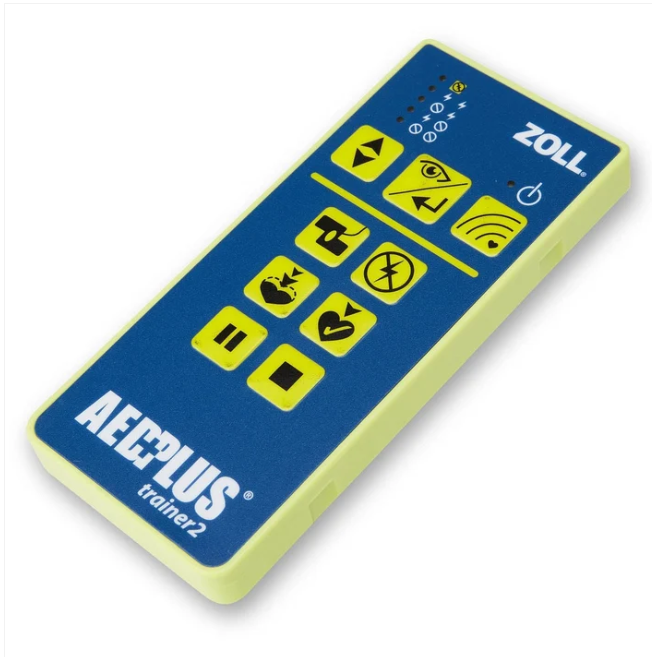
ZOLL AED Plus Trainer 2 Wireless Remote Controller
The ZOLL AED Plus Trainer 2 Wireless Remote Controller (8008-0007) allows instructors to control the ZOLL AED Plus Trainer 2 from anywhere in the training room, without needing to approach or touch the device during a scenario.
Using the remote, the instructor can switch between five pre-set rescue scenarios by pressing a single button. This allows the training session to flow naturally; the instructor can observe trainees, provide verbal prompts, and change the scenario outcome in real time, all without disrupting the simulation.
The remote is the primary tool for delivering varied, instructor-led AED training with the ZOLL AED Plus Trainer 2. Without it, scenario mode is not available. This page is for the wireless remote only; it is not a replacement for the AED Plus Trainer 2 device itself.
For the ZOLL AED Plus Trainer 2 unit, see: ZOLL AED Plus Trainer 2 Training Defibrillator
Key Features:
Key Features:
- Wireless remote controller for the ZOLL AED Plus Trainer 2 (AED Plus Trainer II)
- Five scenario push buttons: Manual Scenario Mode, Shock–Shock, Shock–No Shock, No Shock–No Shock, No Shock - Shock
- No external wiring required, wireless operation throughout the training room
- Includes 2 x AA batteries
- Lightweight at 0.6 lb
The five scenarios explained
The remote controller has five push buttons, each setting a different scenario outcome on the ZOLL AED Plus Trainer 2:
Manual Scenario Mode: Gives the instructor full manual control over the trainer's rhythm and prompts. Used when the instructor wants to direct the scenario step by step rather than selecting a pre-set shock/no-shock outcome.
Shock – Shock: The trainer presents a shockable rhythm for both analysis cycles. Trainees must recognise the rhythm and follow through with both shock deliveries.
Shock – No Shock: The trainer presents a shockable rhythm on the first analysis, then a non-shockable rhythm on the second. Trainees must recognise when a shock is advised and when it is not.
No Shock – No Shock: The trainer presents a non-shockable rhythm for both analysis cycles. Trainees must recognise that CPR continuation is the correct response rather than attempting defibrillation.
No Shock – Shock: The trainer presents a non-shockable rhythm first, then a shockable rhythm. This scenario trains trainees to respond correctly to a rhythm that changes during resuscitation.
| Brand | ZOLL |
|---|