
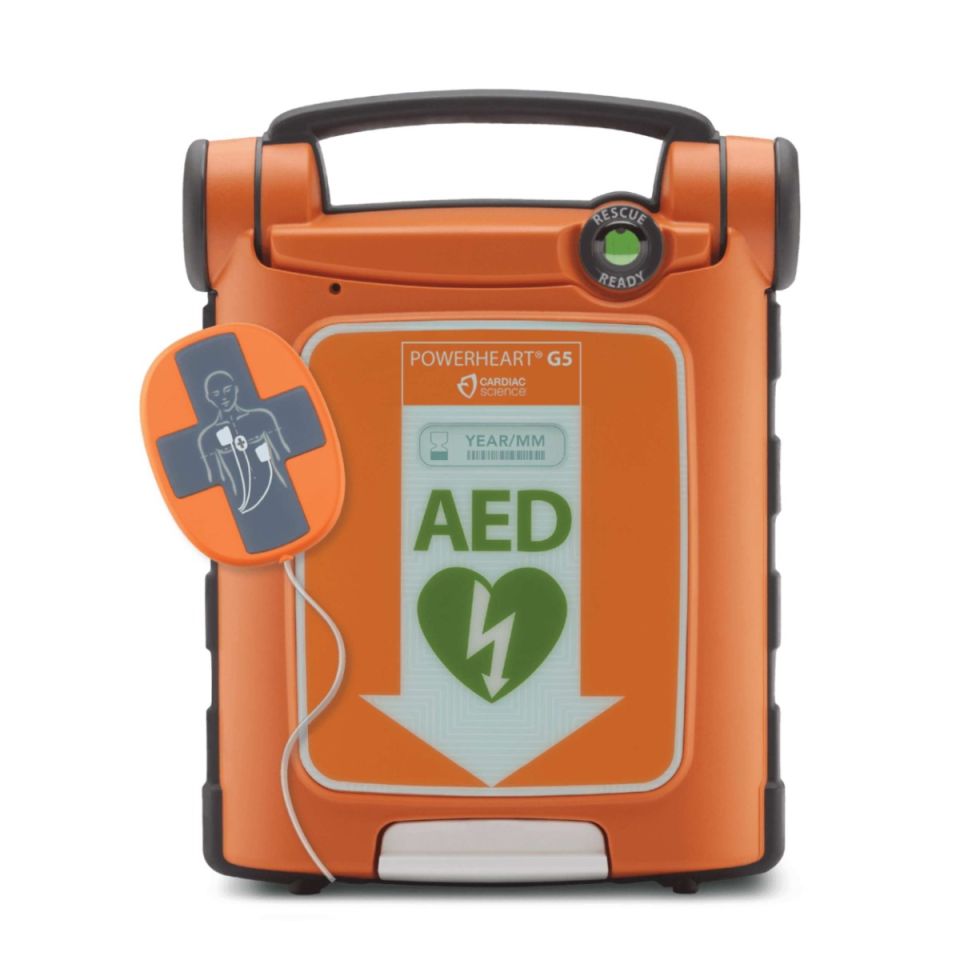
Powerheart G5 Fully Automatic Defibrillator (with iCPR) - Aviation Model
The Powerheart G5 Fully Automatic AED Aviation Package is the certified configuration of the Powerheart G5 for deployment on commercial aircraft. The package differs from the standard G5 in one critical respect: it includes a TSO-C142a approved battery pack, tested and certified to meet FAA Technical Standard Order requirements for aviation AED batteries.
The device itself is the same proven G5 platform used across workplaces, public venues, and healthcare settings throughout the UK. What the aviation package provides is the documented compliance that aircraft operators require, a certified battery, the relevant standards data, and confirmation that the unit meets RTCA DO-160G vibration and EN electromagnetic compatibility requirements for use aboard commercial aircraft.
For the full Powerheart G5 feature breakdown, see the main Powerheart G5 product page. This page covers the aviation-specific configuration, certification, and what's included in the aviation package.
Key Features
- Real-time CPR coaching
- Rescue Coach user-paced prompting
- Dual-language prompting
- Daily, weekly and monthly self-testing
- IP55 rated and drop-tested from 1m
Aviation Certification
Commercial aviation AEDs are subject to a specific set of technical requirements covering battery performance, vibration tolerance, electromagnetic emissions, and radiated immunity. The Powerheart G5 Aviation Package is configured to meet these standards. More in the 'details' below.
For more information on this defibrillator, or to find out about how we can combine this device into a money-saving package deal for you, please contact one of our Defib Experts using the web chat, or give us a call on: 01298 872 186
Fully automatic shock delivery
The G5 analyses heart rhythm and delivers a defibrillation shock automatically when clinically indicated, without the rescuer needing to press a shock button. Pre-shock pause is under 10 seconds after CPR. This is well-suited to situations where the responder may be a flight attendant or trained cabin crew member rather than a clinical professional.
iCPR real-time CPR coaching
The iCPR pads measure compression rate and depth during CPR and provide corrective prompts, 'Press Harder', 'Good Compressions', in real time. For crew performing CPR at altitude or under stress, this coaching has a measurable effect on the quality of compressions delivered between shocks.
Rescue Coach user-paced prompting
Step-by-step voice and text prompts guide the rescuer through the full rescue sequence. The device adapts to the responder's pace and actions rather than running on a fixed timer, which reduces the risk of critical steps being missed under pressure.
Dual-language prompting
Switch between two pre-set languages at the press of a button. Useful on international routes where the attending crew member may not be a native English speaker.
Rescue Ready self-testing
Daily, weekly, and monthly self-tests check the battery, electrode pads, and internal hardware. A green Rescue Ready indicator confirms the device is operational. The G5 performs these checks automatically, no manual inspection needed between scheduled maintenance intervals.
IP55 rated and drop-tested
Rated IP55 for dust and water protection, and drop-tested to 1 metre to military standards. Built to perform reliably in the varied conditions of aircraft cabins and cargo environments.
Rescue data transfer
Post-rescue event data is transferable via USB for incident reporting, clinical review, and airline compliance records.
AED Aircraft Compatibility
TSO-C142a - Battery certified for aircraft: TSO stands for Technical Standard Order; it's the FAA's way of saying "this component has been independently tested and approved for use on aircraft." The C142a specifically covers AED batteries. It means the battery has been proven to work reliably under the conditions you'd find on a commercial flight, pressure changes, temperature swings, and the vibration of being airborne. Without this, an AED battery is not considered airworthy.
RTCA DO-160G, Section 8 - Aircraft vibration tested: RTCA DO-160G is the bible for testing electronic equipment on aircraft. Section 8 specifically covers vibration. It simulates what a device experiences during takeoff, turbulence, and landing on both fixed-wing aircraft (planes) and rotary-wing aircraft (helicopters). Passing this test means the G5 won't malfunction because of the physical stress of being on a plane.
EN 55011 / CISPR 11- Electromagnetic emissions: Every electronic device emits a small amount of electromagnetic "noise." On an aircraft, this is a big deal because that noise can potentially interfere with the plane's navigation and communication systems. This standard sets a limit on how much electromagnetic noise the AED is allowed to emit. The G5 stays within those limits; it won't interfere with the aircraft's electronics.
IEC 60601-1-2 -Radiated immunity: This is the flip side of the above. Rather than what the AED sends out, this covers what it can withstand coming in. Aircraft environments are full of electromagnetic signals, radar, radio, and other avionics. This standard confirms that the G5 won't be disrupted by those signals when it needs to work. It's still going to function properly even in a high-interference environment.
Technical Specification
| Shock energy (adult) | 95J - 354J (escalating) |
| Shock energy (child) | 22J - 82J (optional paediatric pads, sold separately) |
| Weight | 2.1 kg |
| Dimesions | 24.5 x 23.5 x 9.5 cm |
| Electrode pad lifespan | 2 years |
| battery life | 4 years |
| Warranty | 6 years (extendable to 8 years with registration) |
Frequently Asked Questions
What is iCPR and how does it support in-flight resuscitation?
iCPR is the real-time CPR feedback system built into the Powerheart G5 electrode pads. During chest compressions, the pads measure rate and depth and relay that data to the device, which provides corrective voice and visual prompts throughout. This is particularly valuable in aviation settings where flight crew may not perform CPR regularly and benefit from live coaching on compression quality.
What is the difference between the automatic and semi-automatic G5 aviation versions?
The fully automatic version analyses heart rhythm and delivers a defibrillation shock without the rescuer pressing anything. The semi-automatic version analyses the rhythm and then prompts the rescuer to press a shock button. For commercial aviation, where crew may have varying levels of resuscitation training, the automatic version removes a potential point of delay in the rescue sequence.
| Brand | Cardiac Science |
|---|