
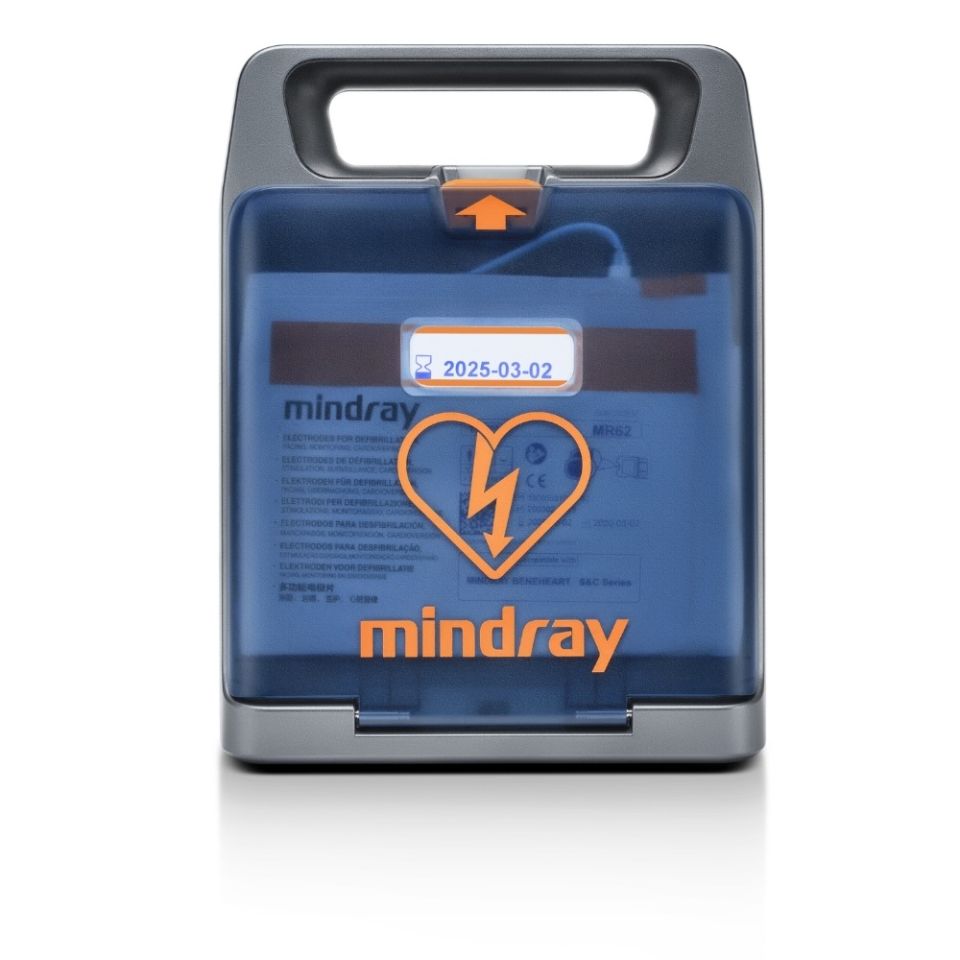
Mindray BeneHeart S1A Semi-Automatic Defibrillator
The Mindray BeneHeart S1A Semi-Automatic is an AED for workplaces, schools and community buildings. It's the same defibrillator as the Mindray BeneHeart C1A, in a blue case instead of orange. Open the lid, and it turns on and guides you through the rescue. It reads the heart's rhythm in under five seconds, and if a shock is needed, it has already charged by the time the analysis finishes.
This is the semi-automatic version. The S1A decides whether a shock is needed and tells you when; you press the flashing shock button to deliver it. It suits places where the people most likely to respond have some first aid training and want to control that moment.
Key features
- Semi-automatic: the AED advises a shock; you press the button
- Shock-ready in under 8 seconds from switch-on
- Escalating adult energy: 200 J, 300 J, then 360 J
- One set of pre-connected pads for adults and children, with a child mode switch
- Voice prompts that adapt to how confident the rescuer is (ResQNavi)
- CPR metronome and coaching to current resuscitation guidelines
- Battery and pads both last up to 5 years in standby
- IP55 dust and water resistance, tested to a 1.5 m drop
- Daily self-tests, with a status indicator you can check at a glance
- Same pads and battery as the Mindray BeneHeart C1A
- 8 year warranty
Not sure whether you need semi or fully automatic, or need more info on the unit. Call us on 01298 872 186. Tell us where the AED will go and who's likely to use it, and we'll give you a straight recommendation.
Semi or fully automatic: which is right for you?
In both versions, the S1A makes the medical decision. It analyses the heart rhythm and only advises a shock if it finds a shockable rhythm. Either way, it talks you through placing the pads and doing CPR. The only difference is who delivers the shock.
With this semi-automatic version, the AED tells everyone to stand clear, lights the shock button and waits for you to press it. That gives the rescuer a last moment to check nobody is touching the patient. The trade-off is that someone under pressure can freeze, and every second of hesitation delays the shock.
Prompts that adjust to the rescuer
People react very differently in a real cardiac arrest. Mindray's ResQNavi system watches how long each step takes. If the rescuer hesitates, for example by not applying the pads for a while, the prompts become more detailed: "Remove pads package from lid of AED. Tear open package." A confident rescuer gets shorter prompts and isn't slowed down. The device also has language options.
Under 8 seconds from switch-on to shock
Every minute without a shock lowers the chance of survival, so the S1A cuts out waiting time. It powers on in under 2 seconds when you open the lid. It analyses the rhythm in under 5 seconds and charges at the same time, so there's no separate charging pause. From switch-on to ready to shock takes under 8 seconds, not counting the time to apply the pads. This feature also allows you to keep the CPR pause time at a minimum, increasing survival outcomes.
Escalating energy up to 360 J
After the first shock, the S1A raises the energy: 200 J, then 300 J, then 360 J for adults. Some people need a higher-energy shock to reset the heart, and many public-access AEDs top out at 200 J. Mindray cites the 2025 European Resuscitation Council guidelines, which favour escalating higher-energy regimes over repeated fixed low-energy shocks. The S1A also adjusts each shock to the patient's body resistance (impedance).
One set of pads for adults and children
The pads come pre-connected and work for both adults and children, so there's no hunting for a second set. For a child under 8 years old or under 25 kg, press the child mode switch. The S1A then lowers the energy to 100–100–200 J and changes the CPR guidance to suit a child.
CPR coaching
Between shocks, the S1A coaches CPR with a metronome to set the pace and spoken encouragement to keep the rescuer going. CPR mode can be set to 30:2 (ie, 30 compressions and 2 rescue breaths), 15:2 or hands-only to match your training. Real-time feedback on compression depth and rate needs the optional CPR sensor (bought separately)
Built as a public access defibrillator
The S1A runs a self-test every day, plus weekly, monthly and quarterly checks, and shows its status on the indicator. It's rated IP55 against dust and water jets, drop-tested from 1.5 m, and operates from −5 to 50 °C. For an outside wall in a UK winter, put it in a heated cabinet.
What it costs to run
The battery and pads each last up to 5 years in standby, so a device that isn't used needs nothing new for 5 years. After a rescue, you replace the pads. Replacement C-series pads are £56.00 + VAT and a replacement battery is £235.00 + VAT.
S1A or C1A: what's the difference?
Only the colour. Mindray covers the C1A and S1A in the same operator's manual, and they share the same pads, battery, specifications and performance. The S1A comes in blue, and the C1A comes in orange. Choose on price and/or availability.
Technical Specifications
|
Specification |
BeneHeart S1A Semi-Automatic |
|---|---|
|
SKU |
0654B-XA00031 |
|
Operation |
Semi-automatic (user presses shock button) |
|
Waveform |
Biphasic truncated exponential (BTE), impedance compensated |
|
Adult energy |
200–300–360 J escalating (selectable 100–360 J) |
|
Child energy |
100–100–200 J (selectable 10–200 J) |
|
Power-on time |
Under 2 seconds |
|
Rhythm analysis |
Under 5 seconds |
|
Charge time |
0 seconds (charges during analysis) |
|
Switch-on to shock-ready |
Under 8 seconds |
|
Patient impedance range |
25–300 Ω |
|
Prompts |
Adaptive voice prompts (ResQNavi), CPR metronome |
|
Display |
1.96" dot-matrix |
|
Languages |
Up to 3, switchable |
|
Dimensions |
21.0 cm W × 28.6 cm D × 7.8 cm H |
|
Weight |
2.0 kg ± 0.4 kg including battery |
|
Ingress protection |
IP55 |
|
Drop test |
1.5 m |
|
Operating temperature |
−5 to 50 °C |
|
Battery |
Li/MnO₂, 4,200 mAh, disposable |
|
Battery standby life |
5 years |
|
Battery capacity |
400 shocks at 200 J or at least 15 hours' use |
|
Pads |
Pre-connected adult/child, 5-year shelf life |
|
Self-tests |
Daily, weekly, monthly, quarterly |
|
Data storage |
500 events, 1 h voice, 5 h CPR data, 1,000 self-test records |
|
Data export |
USB |
|
Warranty |
8 years |
In the box: BeneHeart S1A AED, pre-connected adult/child pads, battery, user manual
Frequently Asked Questions
What's the difference between the Mindray S1A and C1A?
The colour. The S1A is blue and the C1A is orange. They're covered by the same Mindray operator's manual and share the same pads, battery and specifications.
What's the difference between the S1A and the S2A?
The S2A adds a 7-inch colour screen with animated instructions. The S1A has a small text display and relies on voice prompts. It's 300 g lighter, and its battery gives 400 shocks against the S2A's 350.
Can someone with no training use the semi-automatic S1A?
Yes. The voice prompts tell them exactly when to press the shock button, and the S1A only advises a shock if one is needed. The real risk is hesitation; in a real emergency, citizen responders function on adrenaline, and they're fighting against all the natural instincts of flight. Training is recommended because it gives that confidence to rescuers to know that whatever they do is much more than doing nothing in the context of a cardiac arrest.
What happens if nobody presses the shock button?
No shock is delivered. The S1A keeps prompting you to press the flashing button. Mindray's quick guide for the C-series, which shares the S1A's design, gives a 30-second window. If the button still isn't pressed, the AED cancels the shock and tells you to carry on with CPR.
Can I use the S1A on a child?
Yes. Use the same pads and press the child mode switch for a child under 8 years or under 25 kg. The energy drops to 100–100–200 J, and the CPR prompts change to suit a child.
Can it speak more than one language?
It can be set up with up to three languages, switchable with a button.