
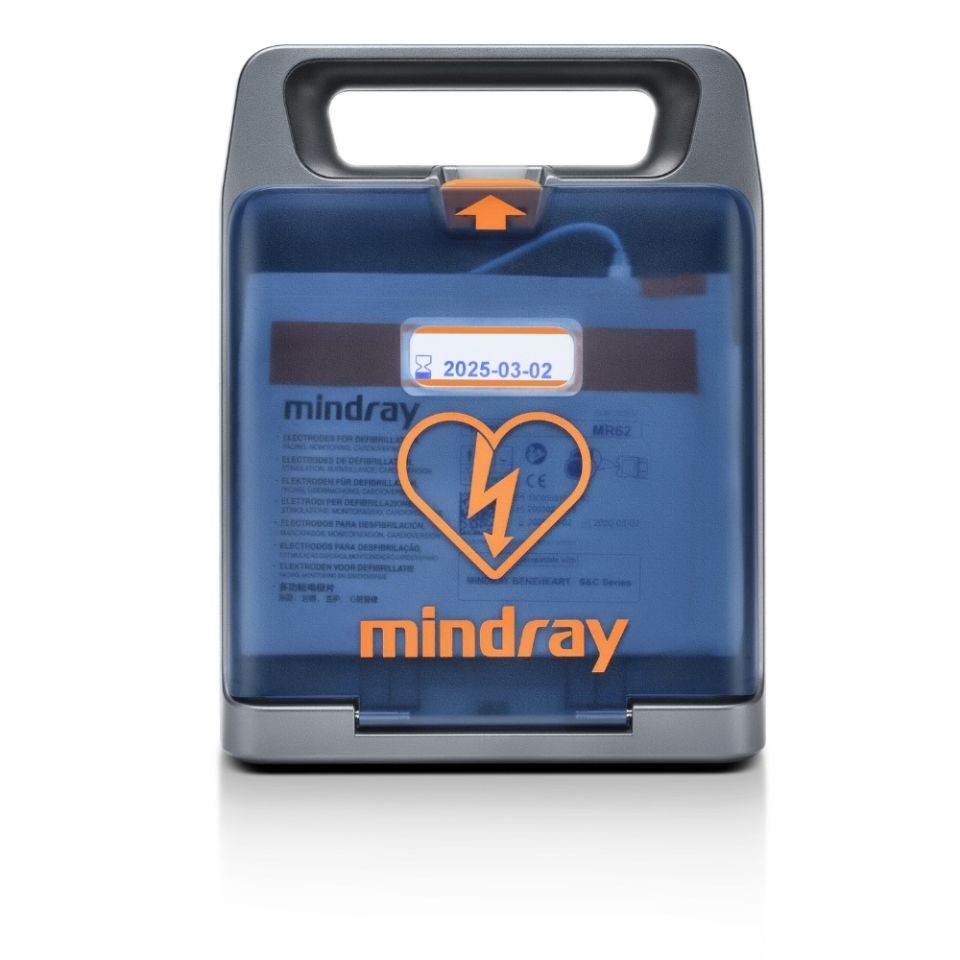
Mindray BeneHeart S1A Fully Automatic Defibrillator
The Mindray BeneHeart S1A Fully Automatic is an AED for places where anyone could be first on the scene: village halls, shops, sports clubs and public wall cabinets. It's the same defibrillator as the Mindray BeneHeart C1A Fully Automatic, in a blue case instead of orange. Open the lid and it switches on and talks the rescuer through every step.
Being fully automatic, it removes the hardest moment for someone with no training. If a shock is needed, the S1A warns everyone to stand clear and delivers the shock itself. Nobody has to find and press a button under pressure.
Key features
- Fully automatic: no shock button to press
- Spoken "stand clear" warning before every shock
- Shock-ready in under 8 seconds from switch-on
- Escalating adult energy: 200 J, 300 J, then 360 J
- One set of pre-connected pads for adults and children, with a child mode switch
- Voice prompts that give more detail when the rescuer hesitates (ResQNavi)
- CPR metronome and coaching
- Battery and pads both last up to 5 years in standby
- IP55 dust and water resistance, tested to a 1.5 m drop
- Daily self-tests and a status indicator
- Same pads and battery as the Mindray BeneHeart C1A
- 8 year warranty
Buying for a community or public site? Call us on 01298 872 186. We can supply the AED with an outdoor cabinet and signage and bundle it as a money-saving package.
Fully automatic: the AED delivers the shock
The S1A reads the heart rhythm through the pads and only shocks if it finds a shockable rhythm. When it does, it tells everyone to stand clear and not touch the patient, then delivers the shock itself. The rescuer's job is to place the pads, keep clear when told and start CPR when prompted.
That matters most when the person who reaches the AED first may never have used one. Under pressure, some people freeze at the shock button, and every second of delay lowers the chance of survival. A fully automatic AED takes that decision away.
Guidance that adjusts to the rescuer
Mindray's ResQNavi system tracks how long each step takes. If the rescuer stalls, for example by not getting the pads on, the prompts become more detailed. Someone who knows what they're doing gets shorter prompts and isn't held up.
Fast to the first shock
The S1A switches on in under 2 seconds when the lid opens. It analyses the rhythm in under 5 seconds and charges during the analysis, so it's ready to shock in under 8 seconds from switch-on, not counting the time to apply the pads. This reduces the CPR pause time and could possibly increase survival outcomes.
Up to 360 J for adults
Adult shocks escalate from 200 J to 300 J to 360 J if earlier shocks don't work, and each one is adjusted to the patient's body resistance. Mindray cites the 2025 European Resuscitation Council guidelines, which favour escalating higher-energy shocks over repeated fixed low-energy ones.
Suitable for children
The same pre-connected pads work for adults and children. For a child under 8 years or under 25 kg, press the child mode switch. The S1A lowers the energy to 100–100–200 J and adjusts its CPR guidance.
Made for Public Access
The S1A tests itself daily, weekly, monthly and quarterly and shows its status on the indicator. It's rated IP55, drop-tested from 1.5 m and works from −5 to 50 °C. In the UK, an outdoor wall needs a heated cabinet to keep it above that range in winter.
Mindray S1A or Mindray C1A?
The S1A Fully Automatic and the C1A Fully Automatic are the same AED in different colours: blue for the S1A, orange for the C1A. Mindray covers both in one operator's manual, and they take the same pads and battery.
Technical Specifications
|
Specification |
BeneHeart S1A Fully Automatic |
|---|---|
|
SKU |
0654B-XA00032 |
|
Operation |
Fully automatic (no shock button) |
|
Waveform |
Biphasic truncated exponential (BTE), impedance compensated |
|
Adult energy |
200–300–360 J escalating (selectable 100–360 J) |
|
Child energy |
100–100–200 J (selectable 10–200 J) |
|
Power-on time |
Under 2 seconds |
|
Rhythm analysis |
Under 5 seconds |
|
Charge time |
0 seconds (charges during analysis) |
|
Switch-on to shock-ready |
Under 8 seconds |
|
Patient impedance range |
25–300 Ω |
|
Prompts |
Adaptive voice prompts (ResQNavi), CPR metronome |
|
Display |
1.96" dot-matrix |
|
Languages |
Up to 3 |
|
Dimensions |
21.0 cm W × 28.6 cm D × 7.8 cm H |
|
Weight |
2.0 kg ± 0.4 kg including battery |
|
Ingress protection |
IP55 |
|
Drop test |
1.5 m |
|
Operating temperature |
−5 to 50 °C |
|
Battery |
Li/MnO₂, 4,200 mAh, disposable, 5-year standby life |
|
Battery capacity |
400 shocks at 200 J or at least 15 hours' use |
|
Pads |
Pre-connected adult/child, 5-year shelf life |
|
Self-tests |
Daily, weekly, monthly, quarterly |
|
Data storage |
500 events, 1 h voice, 5 h CPR data, 1,000 self-test records |
|
Data export |
USB |
|
Warranty |
8 years |
In the box: BeneHeart S1A Fully Automatic AED, pre-connected adult/child pads, battery, user manual.
Frequently Asked Questions
Will a fully automatic AED shock someone who doesn't need it?
No. The S1A only shocks if it detects a shockable heart rhythm through the pads. If the rhythm isn't shockable, it tells the rescuer to continue CPR instead.
What if someone is touching the patient when it shocks?
If someone is touching the patient when an Automated External Defibrillator (AED) delivers a shock, the electrical current can pass into the person making contact, causing sensations ranging from a mild tingle or jolt to muscle contractions, burns, or potentially dangerous heart rhythm disruptions.
Is fully automatic or semi-automatic better for a public access defibrillator?
For a public cabinet, where the first person on the scene could be anyone, fully automatic is usually the safer choice because nobody has to decide to press a button. Semi-automatic suits sites where trained first-aiders will respond.
Will a fully automatic AED shock someone who doesn't need it?
No. The Mindray S1A only shocks if it detects a shockable heart rhythm through the pads. If the rhythm isn't shockable, it tells the rescuer to continue CPR instead.
Does an AED warn before it shocks?
Yes. An AED tells everyone to stand clear and not touch the patient before every shock. The bystanders or rescuers should keep their hands off the casualty.
Is fully automatic or semi-automatic better for a public access defibrillator?
The choice of how to operate the device is entirely up to the customer. We recommend a fully automatic AED (Automated External Defibrillator) for anyone who is untrained and a semi-automatic for trained responders on site. However, every AED is designed to be used by a citizen responder with no training required. It guides the responder through each step of the rescue process. We suggest opting for a fully automatic device in public spaces because responders often hesitate before pressing the shock button, which can potentially delay life-saving treatment. A fully automatic device will initiate a countdown and automatically shock the casualty if necessary. It's important to remember that the responder still needs to perform CPR and apply the pads to the casualty's chest. Ultimately, the choice between automatic and semi-automatic comes down to personal preference.
Can I switch it to semi-automatic later?
No. Fully automatic and semi-automatic are separate models, so choose before you buy. If you're not sure which suits your site, call us on 01298 872 186.
| Brand | Mindray |
|---|